



PTMs in Disease and Infection
Understanding the molecular processes of life requires an understanding of proteins: Almost every biological process involves these biomolecules. It is therefore not surprising that detailed studies of proteins at the molecular level have provided fundamental insights into human biochemistry and cell biology.
Our group is interested in studying the biochemistry and structure of proteins under the influence of interaction partners. In particular, the contribution of posttranslational modifications to the regulation of protein activity is a central research topic in our laboratory.
In this respect, it is interesting to consider the influence of pathogenic bacteria on the function and activity of human proteins: During evolution, these pathogens have developed fascinating mechanisms to manipulate infected human cells by manipulating the activity of key proteins, e.g. by applying posttranslational modifications. The study of the molecular basis of such manipulation processes enables us to identify and describe strategies of pathogens.
PTMs in the context of disease and infection
In the course of evolution, several bacterial pathogens have developed sophisticated strategies to escape their elimination by the human immune system. For this purpose, they release a multitude of bacterial proteins during an infection process, which interfere with essential intracellular processes in the host cell and thus guarantee the survival of the intruder. Our goal is to understand the underlying mechanisms of manipulation of human proteins using selected bacterial factors in molecular detail. For this purpose, we isolate the desired bacterial proteins in high purity, so that we can subsequently study their biochemical and functional properties using biophysical and structural biology methods.
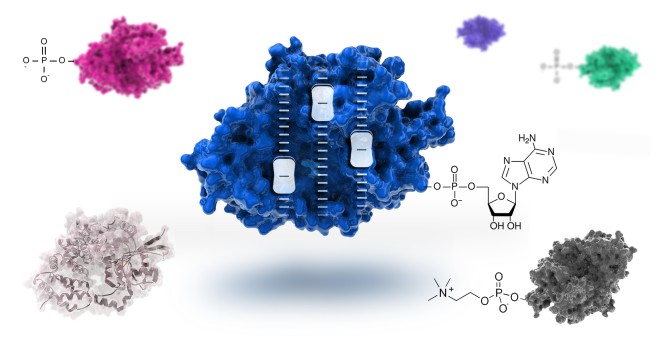
A current focus of our work is the investigation of post-translational modifications (PTMs) that occur in the context of bacterial pathogens. Post-translational modifications are chemical changes in proteins caused by enzymes. These transformations significantly influence the activity and functionality of the modified proteins. Therefore, many pathogens release enzymes that selectively and specifically modify central factors of human cells to give the pathogen an advantage.
Of particular interest for us among the post-translational modifications is the so-called AMPylation of human proteins. Many bacterial pathogens inject enzymes into host cells that use the generally available adenosine triphosphate (ATP) to link target proteins with an adenosine monophosphate (AMP). We now know that the AMP-transmitting enzymes are present in many bacterial pathogens, but their target proteins cannot be predicted.
Therefore, a central topic of our work is the development of methods to identify AMP-modified proteins. For this purpose, we use a spectrum of biochemical, chemical, mass spectrometric and immunological methods, which allow the targeted enrichment and analysis of AMPylated molecules. But also other PTMs (phosphocholination, phosphorylation, proteolysis) are subject of our research.
In addition, we want to understand the biochemical, functional and structural consequences of PTMs in the context of bacterial infections in molecular detail. The introduction and analysis of PTMs (e.g. AMPylations) are technically challenging and require extensive knowledge of the biochemistry and function of the respective proteins and enzymes. A core expertise of our group is therefore the generation of proteins, the introduction of PTMs, and the comprehensive characterization of these molecules. Our research approach enables us to identify targets of bacteria and to study their possible cellular consequences.
Technical Expertise
- Expression and production of purified proteins
- Biophysical characterization of proteins
- Development of enzymatic test methods
Methods available in the institute
- Molecular biology for pro- and eukaryotic systems
- Recombinant protein expression
- Production of pure proteins by chromatographic methods on a multi-milligram scale (affinity and size exclusion chromatography, chromatography systems, proteolytic digestion)
- Mass spectrometric analysis of recombinant proteins
- Biophysical characterization of proteins and protein interactions (fluorescence spectrometry, fluorescence anisotropy, fluorescence titration, isothermal titration calorimetry, thermophoresis, biolayer interferometry)
- Protein crystallization and structure determination by X-ray crystallography.
- Interaction analysis of proteins using yeast 2-hybrid approaches, analytical size exclusion chromatography, affinity studies
- Immunological detection techniques (e.g. Western blotting)
- Establishment of enzyme kinetics (based on fluorescence methods, mass spectrometry, quantifying Western blot and chromatographic methods)
- Eukaryotic cell culture (Hela, CHO, THP1) in combination with fluorescence microscopy
- Establishment of new detection and enrichment methods for post-translational modifications (generation and application of specific antibodies, application of new chemical concepts)
- Stabilization, preparation and characterization of low affinity protein complexes